Saturday, January 8, 2011

Neighborhood Cowboy

"Hook" aka Harold Van Buskirk - circa 1978
It was around 1978.  The two men stood in the middle of the dusty street, about thirty feet apart, eyes locked on one another.  Empty hands held slightly away from their bodies, inches from the revolvers they wore on their hips.  It was a classic showdown between a Sheriff and an Outlaw.  A battle between Good and Evil.  A battle where Good was going to win because Good always won here at the Old West show in the historic Calico Ghost Town near Barstow, CA.  The audience paid good money to see Good win.  And besides the Sheriff was a better shot  then the Outlaw.  At least that’s what everyone thought until...

BLAM!  BLAM!  In a blinding flash of steel and flesh, they drew and shot, seemingly in one motion.  When the smoke cleared, the Sheriff was on his back, a red splotch on his chest.  It wasn’t real blood, the bullets were tiny balloons filled with red paint.  But they hurt like heck, and the Sheriff was wincing in pain.  The show director balled out the cantankerous Outlaw...then offered him the job of Sheriff.  The Outlaw turned him down.  Playing the Bad Guy was just more fun recalls quick draw artist, Harold Van Buskirk.  “I didn’t want to wear a badge.  I liked jumping behind stuff and shooting up the town.”  

Harold now lives here in the M Street neighborhood.  He goes by the nick-name, Hook, because like the fabled “Captain Hook” he’s missing a hand, the result of a childhood accident.  Raised in Pennsylvania, he moved to Los Angeles to escape the frigid winters.  In the early 70’s, he began frequenting the Pioneer Club on Lankershim Boulevard where bands played the “outlaw” country music of Waylon Jennings and Willie Nelson.  He developed a taste for cowboy boots and western style clothes.  Then a friend introduced him to the art of the fast draw.  At a  gun store in Hollywood, he bought a matched pair of nickel-plated, pearl-handled, single action Colt 45’s.  He practiced night and day drawing the guns out of the hand-tooled leather holsters, every week getting a little quicker.  At the San Angeles shooting range, he shot at targets until he could shoot a bulls eye almost every time.  

One day, a talent scout from the Calico Ghost Town saw him shooting and invited him to join the cast of the Wild West show.  Joining the Cowboys of Calico was a bit of an honor in those days.  Not only was it a popular tourist destination, it was a popular movie location for westerns.  And it was a place where movie stars could test their gun skills against each other.  The contests took place in the back stage area, away from the public.  Hook remembers seeing Steve McQueen and Sammy Davis, Jr. go at it.  Big money was at stake.  The loser had to pay the winner about ten thousand dollars, Hook recalls.   “It wasn’t a friendly thing.  They really didn’t like each other.”  McQueen won the contest, but Davis wanted to go again.  McQueen turned him down.  Later that day, Hook showed McQueen his matched pair of Colt 45’s.  McQueen loved them and offered Hook five thousand dollars for the pair.  This time, it was Hook who turned down McQueen.

While Hook participated in the Old West shows in Calico, he pursued an acting career in Los Angeles, appearing as an extra in numerous films and TV shows including “Starsky & Hutch,” “The Champ,” “Hill Street Blues,” “St. Elsewhere,” “Battlestar Galatica,” and Steve McQueen’s last film, “The Hunter.”  Even though Hook wore a prosthetic hand that virtually hid his disability, he felt casting agencies were prejudiced against anyone who was different.  Eventually, he was blackballed as a “trouble-maker” even though he showed up on time and was always cooperative on set.  Pursuing acting work, “just wasn’t worth it any more,” he recalls.

Hook became an entrepreneur, bidding on close-out liquidations, buying merchandise by the truck load and selling it at flea markets, swap meets, and garage sales.  “Sometimes you make good money.  Other times you just break even.  But it keeps me busy,” Hook told me.  These days he has trouble walking long distances so he rides a blue motorized scooter when he walks his Siberian Husky, Wolfie.  But he still adheres to the cowboy code by living each day with courage, taking pride in his work, and knowing that some things--like your pearl-handled colt revolvers-- just aren’t for sale at any price.

Sunday, June 27, 2010

1940: Kay Marvis

Her name was Kay Marvis.  For a few years, she was married to actor Leo Gorcey, star of the Bowery Boys movies.   Later, she married Groucho Marx. In the 1940’s, she lived in Sherman Oaks, just two blocks from where I live now.  Through a series of chance encounters, I was able to interview people who actually knew her, and obtain a number of rare photographs of her.  Like any good editor, I was compelled to tell her story.  I hope you enjoy it.  -  Jeff


Saturday, May 22, 2010

1940: Fulton & Moorpark

A few months ago, while walking my dogs, I ran into a neighbor who introduced me to Jean Morrison, a woman who grew up in Monterey Village during the 1940's.  Jean told me some fascinating stories of that time, and I've posted my interview with her below.  Here's some highlights:


  • Jean's parents bought the lot at 4420 Fulton Avenue and built a 2 bedroom, 1 bathroom house.  Total cost:  $5,000.  Jean lived there from elementary to high school.
  • The neighborhood was safe.  There was very little traffic on Fulton.  The kids played "kick the Can" and "hit the bat" right in the middle of the street.
  • Penny Singleton, the actress who portrayed "Blondie" in the movies, lived across the street from Jean.
  • Next door to Penny Singleton's house was a large walnut orchard with a large barn on the property.  Many years later a woman gave Jean a picture of that barn.  That picture appears below.
  • Two doors down from Jean's house, lived an executive from ASCAP, the music rights organization.  Radio stars Phil Harris and Alice Faye visited occasionally and Jean caught glimpses of them.
  • Jean took singing lessons from Kay Marvis.  At the time, Kay was married to actor Leo Gorcey, star of the "Dead End Kids" films.  She appeared in four films with Gorcey.  In the clip below, Marvis and Gorcey compete in a swing dance competition.  Kay divorced Gorcey in 1944 and moved away from the neighborhood.  The next year she married Groucho Marx, becoming his second wife.  They were divorced in 1951.
  • Jean occasionally went to Sunday school and services at the Little Brown Church with her friends.  She watched several full immersion baptisms with great fascination...though she never participated.
  • Jean was married in 1951 and moved away from the neighborhood.  Her parents later moved to Encino and rented the Fulton Avenue house.  Jean inherited the house and, around 1981, sold it.  Condominiums were built on the property.  But, because Jean's house was so well-built, the buyers moved it off the lot to another location.  

See you around the neighborhood! -  Jeff


From 1940: Fulton & Moorpark

The barn pictured above was located near the corner of Fulton and Riverside, just south of the 101 Freeway.

Monday, December 14, 2009

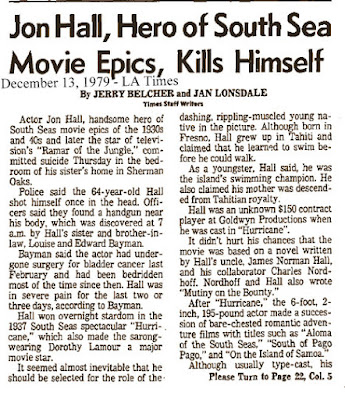
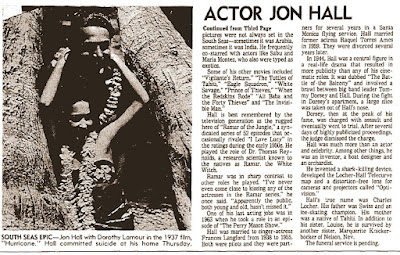
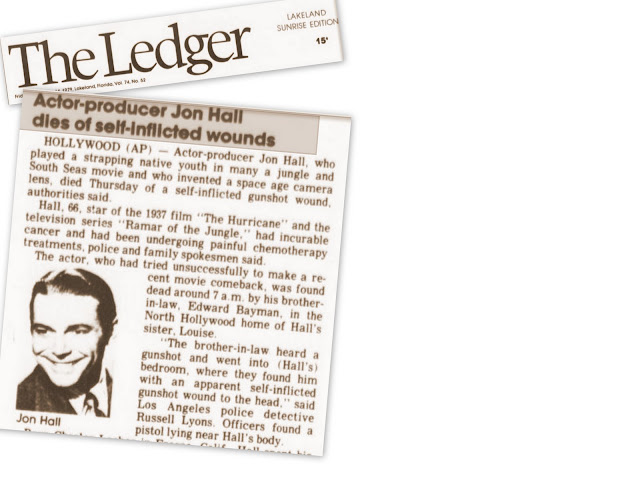
1979 - Actor Jon Hall Dies

While walking my dogs this morning, I met neighbor PL.  When I mentioned I wrote a blog on neighborhood history, he told me about an actor named Jon Hall, who lived the last 10 months of his life in a house on Atoll Avenue near Kling Street.  I hadn't heard of Jon Hall but after my walk, I immediately looked him up on the internet.  Hall was best remembered as the star of the 1937 film "The Hurricane" and the television series "Ramar of the Jungle," a syndicated series of 52 episodes that occasionally rivaled "I Love Lucy" in the ratings during the 1950's.

In 1979, Hall was living at his sister's house on Atoll while undergoing painful chemotherapy treatments for incurable bladder cancer.  PL met Hall.  He learned that Hall was an inventor in addition to being an actor.  Once Hall took a picture of PL's house using a wide screen lens Hall invented.  "The picture was over a foot long, and I've still got it somewhere," PL said. 

On December 13, 1979, Hall's brother-in-law, Edward Bayman, heard a gunshot.  "He ran into Hall's room and found him dead from an apparent self-inflicted gunshot wound to the head," said Los Angeles Police Detective Russell Lyons.  News crews from ABC, NBC, CBS and local television stations descended on the neighborhood to cover Hall's death along with reporters from numerous newspapers.  Vans, cars and trucks were parked up and down Atoll Avenue.  One car blocked the PL's driveway.

As I tried to imagine the media circus in our neighborhood, I realized today--December 13, 2009--was the 30 year anniversary of his death.  It seemed eerie  that I would meet PL on this particular day and he would tell me this particular story.  It felt like I was in an episode of "The Twilight Zone."  But then my wife told me I had the date wrong:  Today is December 14th--not the 13th.  It's the day after the 30th anniversary.  So I guess it's not so eerie after all.  And I won't slip into a wrinkle in time or be abducted by aliens. 

Until next time, I'll see you around the neighborhood.  -- Jeff S.


Thursday, November 26, 2009

1933: T.C. Archer Turkey Farm

The agricultural roots of the San Fernando Valley are well known.  Many small farms dotted the landscape right up until the 1950's.


But today, in honor of Thanksgiving, I want to remember one particular operation:  T.C. Archer's turkey farm, which was formerly located on the corner of Ventura Blvd. and Spence Ave., across the street from Poquito Mas.


We don't know what happened to the T.C. Archer's farm.  But we do know that many of those turkeys probably ended up on Thanksgiving tables.  And we know exactly where his 1 acre site was located.


We also know in place of Archer's turkey farm there is a 7-11 and several other small businesses, including Taste of India, one of my favorite restaurants.  And speaking of food...


...our turkey is almost done so I got to go.  See you around the neighborhood.

Happy Thanksgiving!  -  Jeff

Monday, November 23, 2009

1927: Studio City Heights

In 1935, our neighborhood was named Monterey Village...but in 1927, they called it Studio City Heights.

September 4, 1927 - LA Times


In September of 1927, Coldwater Boulevard was called Diaz and Beeman Realty was feverishly selling lots even as 500 shade trees were being planted and roads of decomposed granite were being laid.

September 18, 1927 - LA Times 


September 11, 1927 - LA Times 


The stock market was soaring and real estate speculation in the San Fernando Valley was rampant.  The opening of Mack Sennett's $800,000 studio at Radford and Ventura--along with the supposed construction of $20,000,000 worth of other studio space--was to create a neighborhood where movie people could walk to work.  Prices were sure to go up.  Even famed movie producer/director, Cecil B deMille got into the game, buying 253 acres between Woodman and Fulton south of Ventura for $400,000 with plans to build "high class estates for motion picture stars employed in the new movie studio." - LA Times July 24, 1927.  What happened to the plans for Studio City Heights?  Most likely the Great Depression put an end to them...but I haven't found any definitive answers.  A history mystery.

Until next time, I'll see you around the neighborhood.  -- Jeff


September 25, 1927


Tuesday, November 3, 2009

Dogs: Bella


Resident since June 2009, Bella enjoys dressing up for holidays like Halloween and Christmas.  She loves walking the neighborhood, mooching treats from passersby.  A talented human trainer, in less then four months, Bella has taught several of these two-footed walkers to dole out goodies to her during her daily walks.   You're a tribute to our species, Bella.  Keep up the good work.  Woof!  -  The Monterey Dog

2009: Smart Growth

Note:  This is the first of a series of articles on issues facing our neighborhood.  "Smart Growth" was originally published as "Neighborhood Population: 1942." 
______________________________________________

Our neighborhood is experiencing a population boom.  It's a boom borne of buildings--not babies.  And over the last five years it's been hard to miss.

In 2005, a single house on Landale was replaced by 5 condominiums.  In 2006, several houses on Fulton were replaced by a four-story apartment building with 40 units.  In 2007, a house on Longridge was torn down and replaced by two houses.  Ditto for several houses on Atoll.  Then there's the new condominiums on Coldwater.  And on and on. 

The increase in housing is a result of the L.A. City Council passing laws that give developers incentives to build more densely, and it's part of a state-wide plan to prevent urban sprawl.  City planners call this new building strategy "suburban infill" and it's one of the tenets of the "new urbanism," a planning philosophy that favors walkable neighborhoods that reduce the need for automobiles.  It sounds pretty good.  But everyone thought it needed a niftier name.

So proponents such as Mayor Villaraigosa and Director of Planning, Gail Goldberg, call it "smart growth."  Opponents like Joel Kotkin call it "Manhattanization."  Kotkin opponent and smart growth advocate, William Fulton, calls it "Pasadena-izing."  (Fulton has a thoughtful commentary on his conflict with Kotkin in Cool v. Uncool and What's the difference between Glendale and Palmdale?)  Jane Usher, former President of L.A.'s Planning Commission calls L.A.'s new growth "densification" and says it facilitates sprawl and promotes congested neighborhoods that invite crime and gridlock.  Journalist David Zahniser questions the whole premise of the new urbanism by asking: "What's smart about smart growth?" 

That's a quick summary of a big issue.  And a cheat sheet to some of the major players.  You can learn more by clicking on the links above.  And by attending the many homeowner association meetings in our area.  But in all these big picture discussions you won't learn a thing about one little issue:  Our neighborhood population.

For that you need to consult the 2000 U.S. Census.  Our neighborhood is made up of Census Tract 1434 Block Group 3 and Census Tract 1434 Block Group 4.  Add the figures for these two groups and you've got our neighborhood total.  Even though the data is a little out-of-date, it still provides an interesting snapshot.  Here's some of the key figures I've gleaned: 


  • Neighborhood Population:  1,942.  The size of a decent small town.
  • Owner occupied residences:  1,057.  That's 54%, 13 points less then the 67% national average, for those who are interested in such comparisons.
  • Renter occupied residences:  885. 
  • An average of 2.32 people lived in each owner-occupied housing unit, whereas an average of 1.66 people lived in each renter-occupied housing unit.  So there's a greater number of people per house then per apartment.  Why?  Houses have more rooms then apartments, I guess.  Seems logical.

Here's some other tidbits that might interest you:

  • You can break out our neighborhood by race, income level, mortgage size, profession and a myriad of other categories.
  • You can compare the figures of our neighborhood with other neighborhoods.  In fact, you can compare our figures with almost any other U.S. geographical designation.  I've prepared a couple spreadsheets that do that for Household Population and for General Housing Characteristics.  And for readers Sven and KHH in "East" Monterey Village, I've even included your neighborhood info (Census Tract 1434, Block Group 2) in the spreadsheet. 

The recent "smart growth" building boom has increased our numbers.  By how much?  We won't know until the 2010 U.S. Census.  In the meantime, "Neighborhood Population 1,942" gives us a general idea of how many people are running around here.  And that's probably "good enough," as my father used to say.


See you around the neighborhood!  -  Jeff

Friday, October 30, 2009

2009 Halloween Update

Other Yard Displays

Next year, I'll have pictures from other neighborhood yard and front door displays.  Sorry I didn't finish the project this year.   But thanks to all those who allowed me to photograph your spooky exhibits. 

Boney Island Website


Boney Island creator, Rick Polizzi, tells me you can see more  pictures and videos of his funny scare fest at the Official Boney Island Website.  There you can play a skeleton game, see the official park map, and even buy Boney Island t-shirts and coffee mugs. 

Boney Island Lives!

In 2007 Rick sold his Boney Island displays on eBay.  However, he tells me, "Bob Baranick, an ex-Disney Imagineer, bought the band and a bunch of other displays and will have it running Friday night October 30 and Saturday night October 31, from dusk to 10pm.  Bob's address is: 14333 Califa Street, Van Nuys CA 91401  (2 blocks east of Van Nuys Blvd, 2 blocks south of Oxnard St)

Stay safe out there this Halloween!

See you around the neighborhood.  --  Jeff S.

Tuesday, October 27, 2009

1998 Halloween: The Legend of Boney Island


Once upon a time--right in the middle of our little neighborhood--a carnival side-show of skeletons magically appeared during the Halloween season.  It happened in the front yard of Rick Polizzi's house on the corner of Morse and Sarah.


When the apparition first began in 1998 it was small.  But over the years it grew to include over 100 moving skeletons, animated with the aid of strings and motors and speaking with the help of hidden speakers.  Inspired by the Coney Island amusement park, Polizzi called his display "Boney Island."


Those who witnessed the annual spectacle say it was more funny than scary.  In 2004, the LA Times described the scene:  "Skeletons perch in the trees, playing trumpets. They climb on one another's shoulders to reach the roof.


In the carnival's batting cage, a skeleton swats at flying bats. Another bowls with his own skull.  By the front door, members of a bony band called The Skeletones play a bone xylophone, a scythe harp and an ax guitar as pumpkins with moving eyes and mouths sing along from the front window. Spiders bob up and down from a thick web in a tree, spouting corny one-liners, including 'Help me kill the Orkin man.'  Above the roof, in Polizzi's piece de resistance, a skeleton floats back and forth in a jack-o-lantern hot-air balloon." 10/30/04 - LA Times.


Every year, thousands of people came to see Polizzi's display.  But after 10 years, the traffic took it's toll on Poizzi's neighbors, and in 2007, he decided to call it quits.

"Boney Island" is gone forever...and we'll miss it.  But we still have the pictures and videos.  And it's spirit lives on in the many smaller, more modest Halloween displays throughout our neighborhood.

Thanks for all the good times, Rick!

See you around the neighborhood. - Jeff S.


P.S. Hollywood Gothique did a nice little video of Boney Island during it's final season.


Wednesday, October 14, 2009

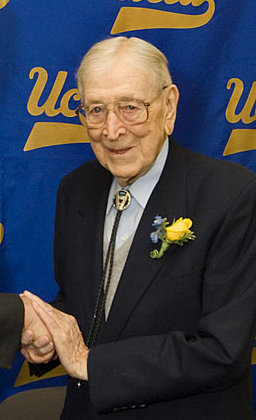
2009: Coach John Wooden turns 99


In Encino--about 4.5 miles from our neighborhood--legendary UCLA basketball coach, John Wooden, has lived in the same modest condominium for the last 30 years.  In the 60's and 70's, Wooden's teams won 10 NCAA National Championships in 12 years, a record unmatched by any other college basketball coach.  Today, Coach Wooden turns 99.  And I wanted to honor him not because I'm a huge college basketball fan--I'm not--but because I admire the inspiring coaching philosophy he developed. 

Wooden was not your typical coach.  "On the first day of practice, I remember him saying, 'I'm not going to be talking to you about winning or losing because I think that's a byproduct of our preparation. I would much rather be focused on the process of becoming the best team we're capable of becoming,'" says John Vallely, who played under Wooden on the 1969 and 1970 UCLA national championship basketball teams.  Underlying this approach was his redefinition of success.  Rather then thinking of success as outperforming an opponent, he said:  "Success is peace of mind which is a direct result of self satisfaction is knowing you made the effort to do the best of which you are capable." 

That attitude helped his teams win championships.  But to me, it's also a sensible way to approach life.  Happy birthday, Coach!

See you around the neighborhood -  Jeff
 

Find out more about the Pyramid of Success at the Official Site of Coach John Wooden
Find out more about John Wooden on Wikipedia or this web page from Congressman Brad Sherman who helped get the Reseda Post Office named in his honor.  


BTW:  In July 2009, I counted 34 basketball hoops in our neighborhood.


Sunday, October 11, 2009

1959 Ford Custom 300

1959 Ford Custom 300


Seen this car in the neighborhood?  Sure it's a classic.  But for "M" this 6 cylinder Ford is also transportation: She drives it to work every day.  "You have to go real slow over Coldwater," she says.


Sunday afternoon I saw "M" lifting bags of potting soil out of the car's spacious trunk.  She told me she's owned it for 18 years.  I said I'd never seen a car quite like this.  She explained that the Custom 300 was basically a "stripped down" version of the  Ford Fairlane.  They called it "the poor man's Fairlane," she told me.   


BTW:  See more classic cars this Wednesday night (10/14) at Van Nuys Cruise Night, sponsored by the Van Nuys Cruising Association.  The action is centered around the  old Rydell Chevrolet lot at the corner of Van Nuys and Burbank boulevards in Van Nuys.  Check out this article by Steve Rosenberg's article in the Daily News for more info.

See you around the neighborhood.  --  Jeff


Monday, September 21, 2009

2000: Neighborhood Pop.

Welcome new subscribers MK, MisterFred and MathWhiz.

And best wishes to MK, who is expecting  a baby any day now.

Last week, I talked with MK about the impending increase in his family population.  That got me thinking about the population figures for our neighborhood.

And it made me realize something:  I didn't know the population figures. Here I'm setting out to tell "many stories" about "one small neighborhood"--the motto of this blog--and I didn't know the size of the "small neighborhood."  I mean I had no idea.  Did 500 people live here?  3000?  700?  I didn't know. 

But I did know our neighborhood was experiencing a population boom.  It's a boom born of buildings--not babies.  And over the last five years it's been hard to miss.

In 2005, a single house on Landale was replaced by 5 condominiums.  In 2006, several houses on Fulton were replaced by a four-story apartment building with 40 units.  In 2007, a house on Longridge was torn down and replaced by two houses.  Ditto for several houses on Atoll.  Then there's the new condominiums on Coldwater.  And on and on. 

The increase in housing is a result of the L.A. City Council passing laws that give developers incentives to build more densely, and it's part of a state-wide plan to prevent urban sprawl.  City planners call this new building strategy "suburban infill" and it's one of the tenets of the "new urbanism," a planning philosophy that favors walkable neighborhoods that reduce the need for automobiles.  It sounds pretty good.  But everyone thought it needed a niftier name.

So proponents such as Mayor Villaraigosa and Director of Planning, Gail Goldberg, call it "smart growth."  Opponents like Joel Kotkin call it "Manhattanization."  Kotkin opponent and smart growth advocate, William Fulton, calls it "Pasadena-izing."  (Fulton has a thoughtful commentary on his conflict with Kotkin in Cool v. Uncool and What's the difference between Glendale and Palmdale?)  Jane Usher, former President of L.A.'s Planning Commission calls L.A.'s new growth "densification" and says it facilitates sprawl and promotes congested neighborhoods that invite crime and gridlock.  Journalist David Zahniser questions the whole premise of the new urbanism by asking: "What's smart about smart growth?" 

That's a quick summary of a big issue.  And a cheat sheet to some of the major players.  You can learn more by clicking on the links above.  And by attending the many homeowner association meetings in our area.  But in all these big picture discussions you won't learn a thing about one little issue:  Our neighborhood population.

For that you need to consult the 2000 U.S. Census.  Our neighborhood is made up of Census Tract 1434 Block Group 3 and Census Tract 1434 Block Group 4.  Add the figures for these two groups and you've got our neighborhood total.  Even though the data is a little out-of-date, it still provides an interesting snapshot.  Here's some of the key figures I've gleaned: 

  • Neighborhood Population:  1,942.  The size of a decent small town.
  • Owner occupied residences:  1,057.  That's 54%, 13 points less then the 67% national average, for those who are interested in such comparisons.
  • Renter occupied residences:  885. 
  • An average of 2.32 people lived in each owner-occupied housing unit, whereas an average of 1.66 people lived in each renter-occupied housing unit.  So there's a greater number of people per house then per apartment.  Why?  Houses have more rooms then apartments, I guess.  Seems logical.

Here's some other tidbits that might interest you:

  • You can break out our neighborhood by race, income level, mortgage size, profession and a myriad of other categories.
  • You can compare the figures of our neighborhood with other neighborhoods.  In fact, you can compare our figures with almost any other U.S. geographical designation.  I've prepared a couple spreadsheets that do that for Household Population and for General Housing Characteristics.  And for readers Sven and KHH in "East" Monterey Village, I've even included your neighborhood info (Census Tract 1434, Block Group 2) in the spreadsheet. 

The recent "smart growth" building boom has increased our numbers.  By how much?  We won't know until the 2010 U.S. Census.  In the meantime, "Neighborhood Population 1,942" gives us a general idea of how many people are running around here.  And that's probably "good enough," as my father used to say.

BTW:  Here are some other insights I've gained from this exercise:

  • You can only look at numbers so long until they stop making sense.
  • Numbers may tell a story...but people are easier to interview.
  • I don't think I have a future in accounting or demography.

Saturday, August 29, 2009

1937: Home Prices

Thanks for your positive response to Edition 00 of Monterey Village.  A few of you have asked me to divulge Sven's real name.  Sorry.  What happens in the blog, stays in the blog.  No real names.  Only real stories.

Onto the business at hand, this email I received from RL:  "Dear Jeff: Enjoyed your brief history of Monterey Village.  As I mentioned at your BBQ last Sunday, I'm thinking of giving up my glamorous life in Hollywood for a quiet, comfortable existence in Monterey Village.  But I worry about buying a home then watching it's value decline.  Historically, how have home prices held up in MV?  Your friend,  RL."

Well, RL, as you know, my econometric model of the real estate market in Monterey Village is one of the best in the business.  Unfortunately, my super computer blew a vacuum tube.  So to answer your question, I'll need to consult a less reliable source:  The Los Angeles Times.

An advertisement in the October 17, 1937 edition (Footnote #1) lists the asking prices of 4 houses in the neighborhood:   $4500, $6350, $6950, and $6750 (Footnote #2).  The average of these four is $6137. 

Now flash forward 73 years to August 29, 2009.  What are those houses worth today.  Zillow.com says:   $680,500, $885,500, $871,500 and $938,000.  Or an average price of $843,875.

That is a 13,649% total average gain!  Or, looked at another way, it's a 6.37% yearly increase compounded annually for 73 years.  Not bad.  Especially considering my savings account is fetching about 1% right now.

Of course, any investment advisor will tell you "past performance is no guarantee of future results."  In other words, despite the findings of this rigorous historical analysis, home prices could go down tomorrow.  Or they could go up.  Or they could stay flat.

So, in the end, I don't have any advice for you, RL.  But I appreciate the opportunity to share my ignorance with you.  And I hope some day, you'll give up that wild life in Hollywood.  As my mother says, "You're not getting any younger."
************************
Footnotes:

1. LA Times - October 17, 1937


2. Investment Returns:  Monterey Village Homes vs. Gold vs. DJIA

                                  1937                       2009             % Gain       

     4653 Longridge:  $4500                    $680,500
     4624 Van Nord   $6350                    $885,500
     4544 Mary Ellen  $6950                    $871,500
     4641 Van Noord $6750                    $938,000

     Avg. Hm. Price    $6137                    $843,875           13,649%

     Gold (per oz.)      $34.79                          $949              2,628%

     DJIA                $135.94  (11/1/37)        $9,539              6,917%